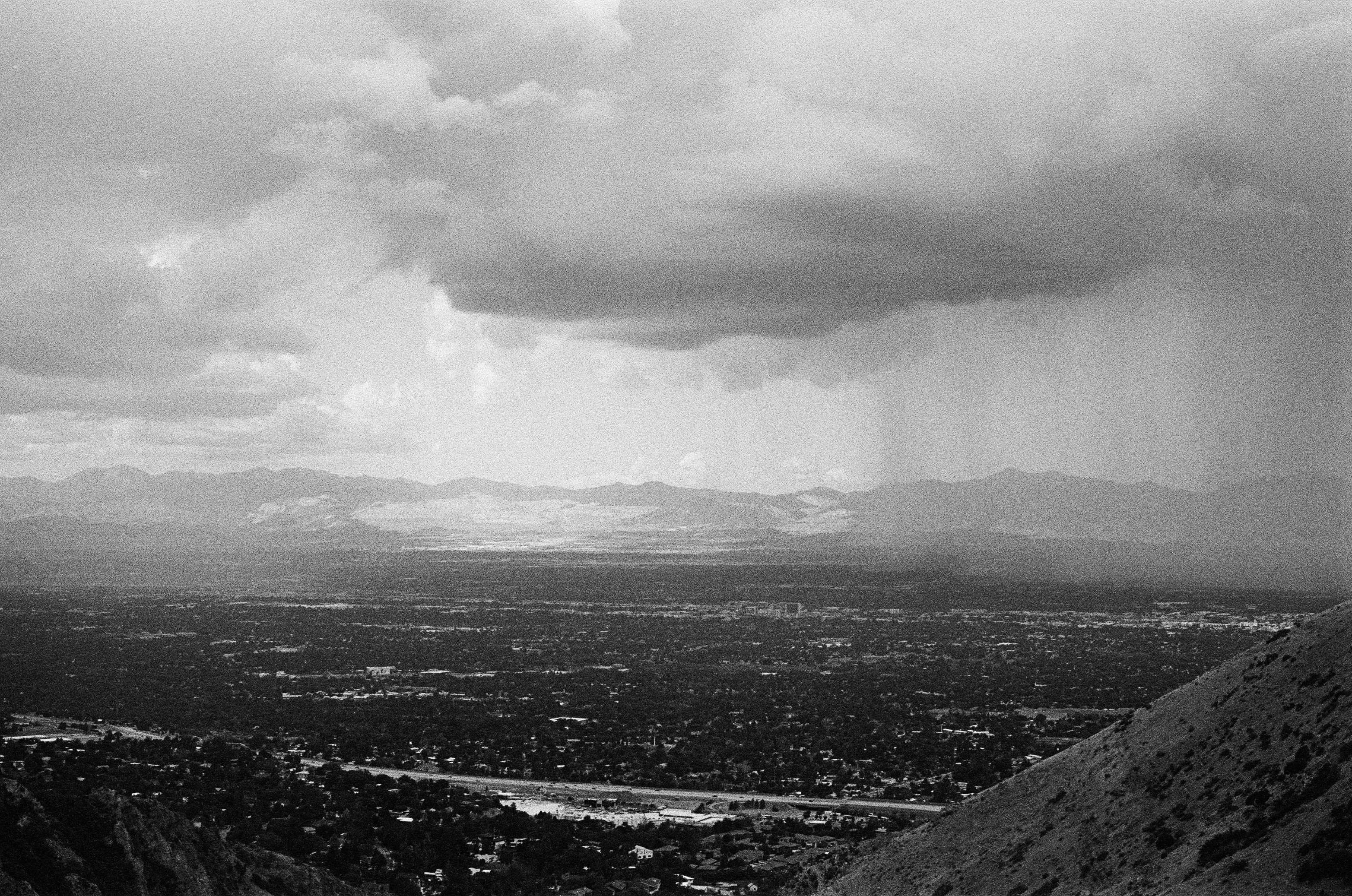
From a young age I was taught to believe a journal is a “continuing record of meaningful experiences that affect our lives,” and that it was a commandment from God Himself to document my feelings as a way of deciphering His influence.1 Growing up in a high-demand religion so focused on archiving our divine existence encouraged me to find joy in recording life’s happenings, and photography consequently became a part of this undertaking.
In developing a conscious awareness of my religious lineage, however, I discovered many of the heroic figures I had received prophetic guidance from were instigators of a colonial expansion on the American West. I then felt my camera became a much more significant tool, one that I could use to contextualize these histories and other related topics through a more contemporary perspective. Thus, my work is conceptually drawn to religious and historical narratives and is visually manifested through both digital and analog post-documentary aesthetics.
An interest in literature has also led me to find the sequencing of photographs is parallel to how a writer might sequence their words and, as a result, both efforts have become essential factors in my practice.
My work originates from a fundamental aspect of photographic theory, to which critic Susan Sontag describes “[Photographs] depict an individual temperament, discovering itself through the camera’s cropping of reality.”2 As such, I find it to be a great privilege and responsibility to share my perspective through the lens of my camera, coincidentally fulfilling the journalistic integrity I was inherently commanded to wield.
_____
1 “Journals.” www.churchofjesuschrist.org, www.churchofjesuschrist.org/study/manual/family-home-evening-resource-book/lesson-ideas/journals
2 Sontag, Susan. On Photography. London, Allen Lane, 1977.
Contact
baileyprigby@gmail.com
@baileyrigbyphoto
Baton Rouge, LA
︎